
Not all plastic waste is created equal.
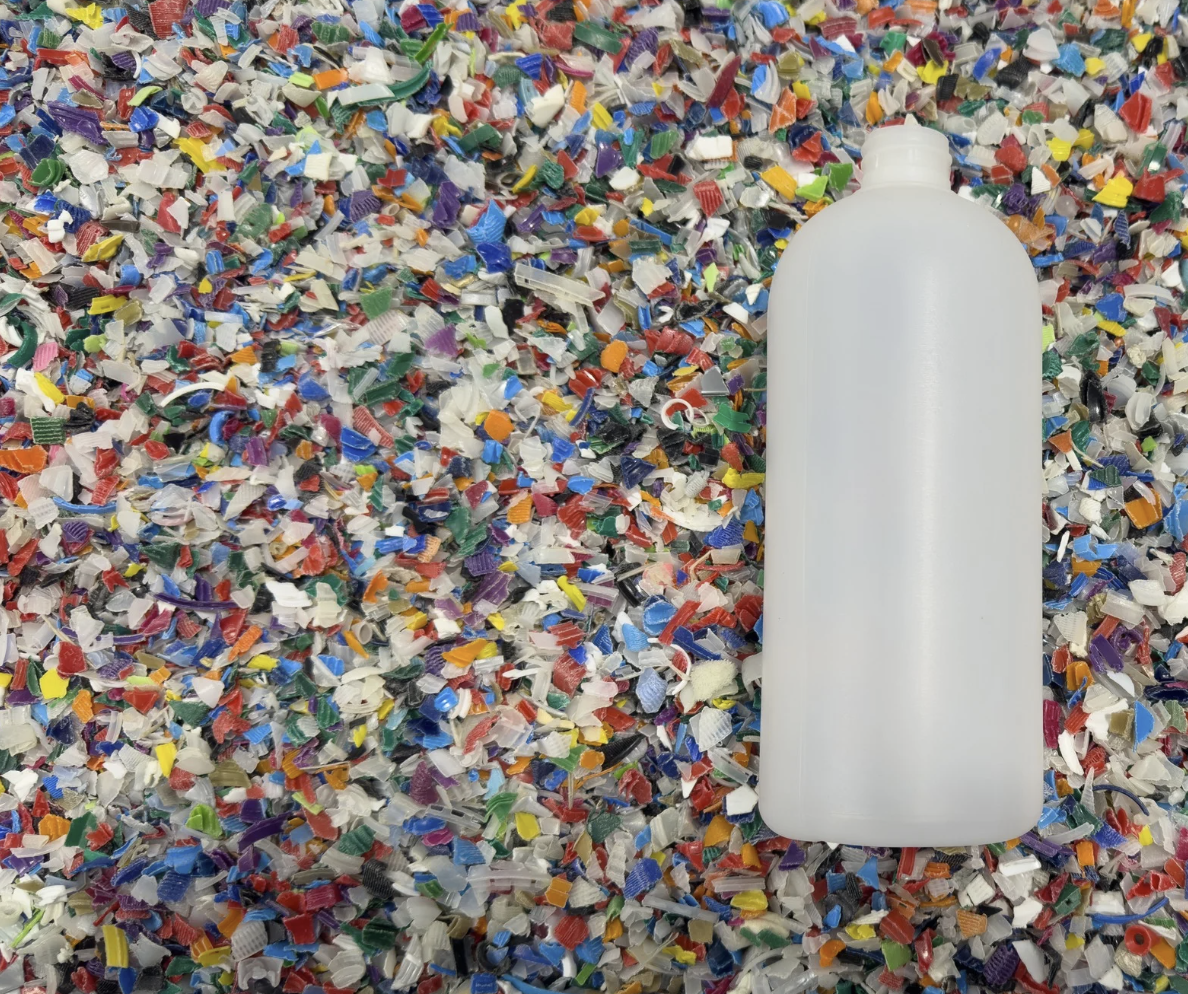
For decades, the coloured HDPE caps that seal bottles around the world have been destined for a one-way journey — collected, shredded, and downcycled into low-value products. This is the destination for much of the plastic waste recycled worldwide.
Today, that story changes.
At ReVentas, we’ve achieved a world first: transforming a waste stream made of injection HDPE waste into a pure, colourless blow-mould grade HDPE suitable for manufacturing new bottles.
It’s proof that even complex, mixed-colour feedstocks can be refined into high-performance, high-purity materials..
The challenge: unlocking value from diversity
Injection-mould grade HDPE (high-density polyethylene) and blow-mould grade HDPE behave very differently when processed. Their molecular structures are tailored to distinct applications: injection-moulded caps require rigidity and flow, while blow-moulded bottles demand elongation and uniform wall thickness. Traditionally, these grades are considered incompatible — one can’t simply be melted and reused as the other.
Using our dissolution technology, we set out to prove that polymer identity isn’t a barrier to circularity. The goal: take a difficult, coloured, mixed-application HDPE waste stream and restore it to the purity, clarity, and rheological performance of virgin blow-mould resin.
The impact: new pathways for circular packaging
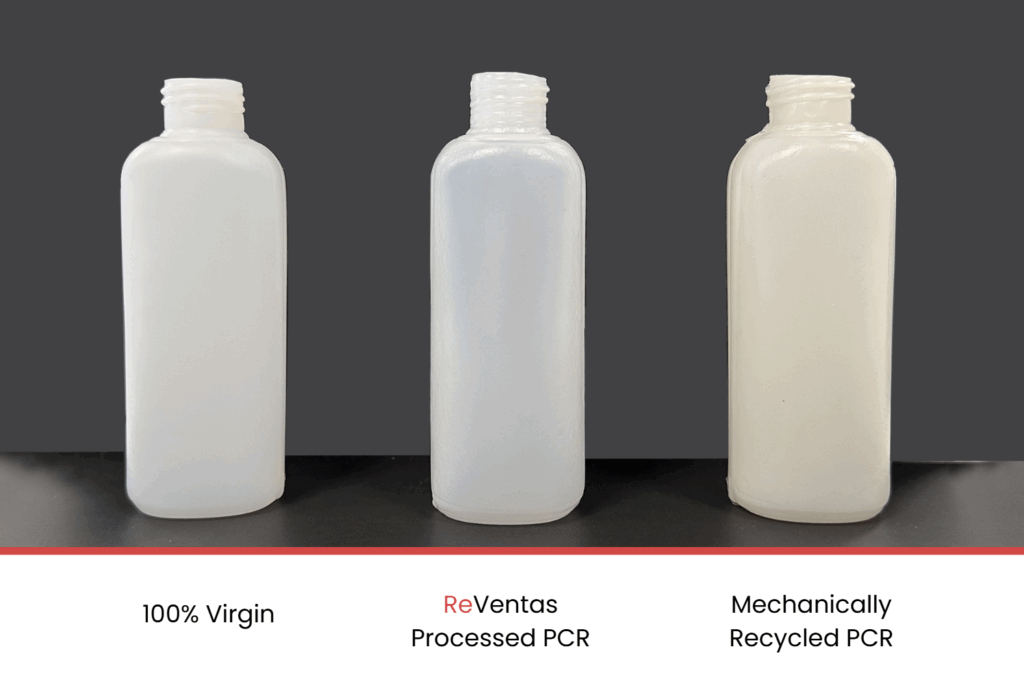
This milestone demonstrates something far larger than a single conversion. It shows how diverse feedstocks — whether caps, closures, tubs, or trays — can be re-engineered into high-performance materials using dissolution technology.
Where mechanical recycling is limited by colour and contamination, and chemical recycling incurs heavy carbon and energy penalties, dissolution sits between the two — preserving polymer integrity whilst recovering a polymer suitable for high end applications.
In practical terms, this unlocks new material flows for circular packaging:
- Injection-mould waste to blow-mould applications
- Coloured post-consumer plastic to clear, food-grade resin
- Mixed packaging streams to single-grade feedstock
It bridges the gap between mechanical recyclers and converters, enabling recycled content to move upstream into packaging formats that only virgin resin could previously satisfy.
A blueprint for scalable purity
This achievement also serves as a blueprint for scaling circular manufacturing. The same process principles behind this cap-to-bottle conversion will underpin our upcoming 10,000-tonne commercial plant, due to begin production in 2028. There, we’ll take complex post-consumer waste streams and consistently deliver virgin-like HDPE — clean, colourless, and ready for reuse in packaging, cosmetics, and pharmaceutical applications.
The future: purity by design
Circularity only works when recycled material can do the same job as virgin — ReVentas’ mission is to provide a solution that can achieve this at scale.
This world-first demonstration proves that selective dissolution can bridge grades, colours, and applications, creating a new generation of recycled materials that meet technical, regulatory, and aesthetic standards.
From caps to bottles, from waste to new high-value products, this is what practical circularity looks like.
To learn more about ReVentas’ selective dissolution technology and how it’s redefining purity in circular packaging, get in touch with our team