
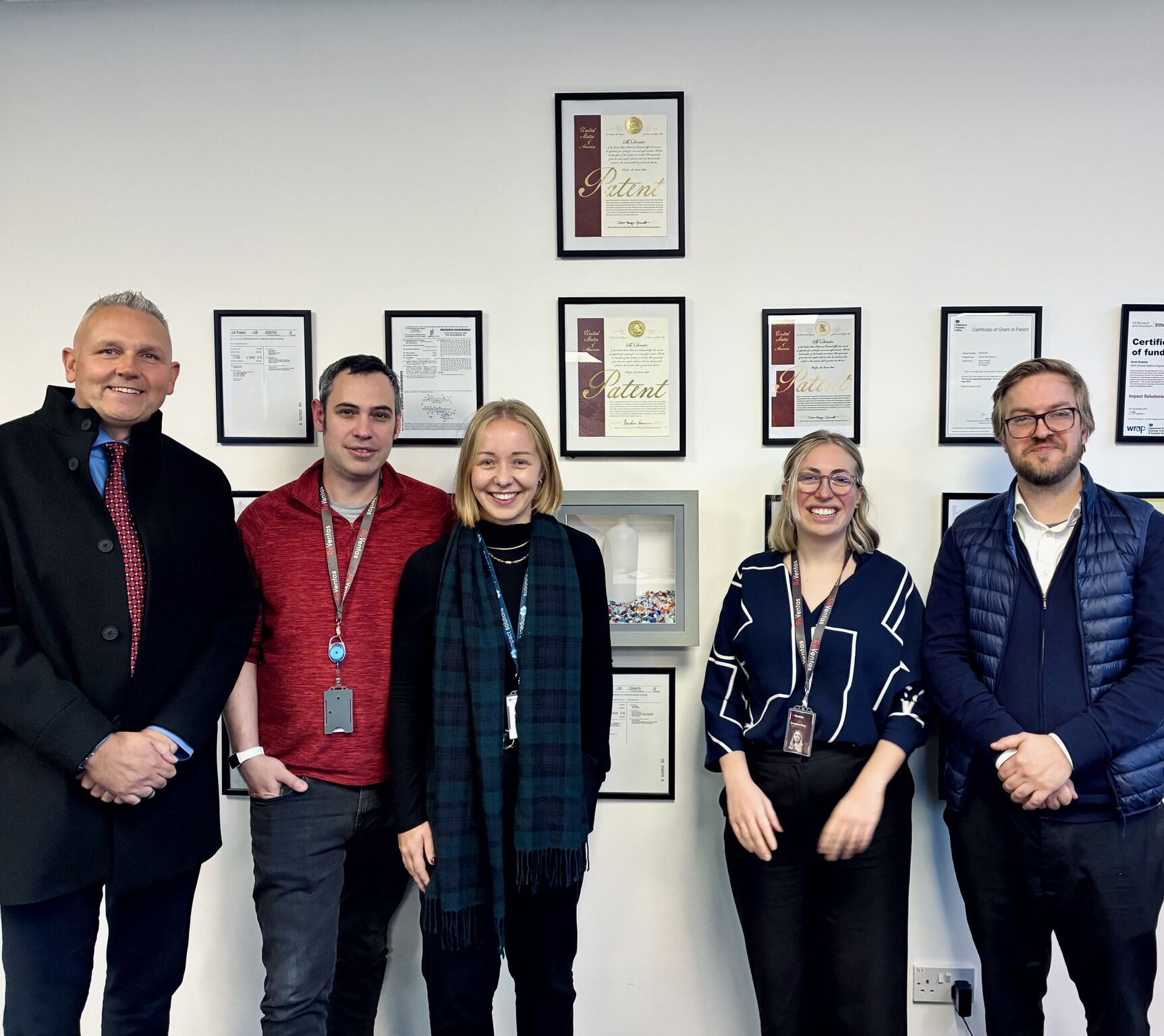
ReVentas was delighted to welcome Jeremy Blake and Esther Carter from PACK UK to our Livingston site last month. The visit provided an invaluable opportunity to exchange ideas about the future of Extended Producer Responsibility (EPR) and how innovation in recycling technology can support the UK’s transition toward a truly circular packaging system.
During the visit, Jeremy and Esther met with the ReVentas team to explore how our dissolution recycling technology is addressing one of the toughest challenges in the packaging sector — the recyclability of flexible polyolefin films. These materials, often printed, laminated, or contaminated, are among the most problematic waste streams in the UK and beyond.
Through a combination of solvent selectivity and process precision, the ReVentas system can purify polyethylene (PE) and polypropylene (PP) films without breaking their polymer chains. By removing inks, adhesives, coatings, and odorous contaminants, the process returns the material to a virgin-like polymer, suitable for reuse in demanding applications such as food-contact packaging.
From pilot to commercial scale
As part of their visit, Jeremy and Esther toured the ReVentas pilot plant, where they saw first-hand how dissolution recycling works in practice. The pilot facility showcases how difficult-to-recycle films can be transformed into high-purity resin that matches the performance of virgin plastic.
The visit also provided an opportunity to discuss how this proven process is being scaled up to ReVentas’ first commercial facility, scheduled to begin operation in 2028. The plant will process tens of thousands of tonnes of mixed post-consumer polyolefins each year, demonstrating how physical recycling can be deployed at an industrial scale to deliver high-quality, low-carbon circular materials for packaging and beyond.
This next phase of development represents a major milestone for ReVentas and for UK innovation in recycling. By moving from pilot success to commercial reality, ReVentas is showing that circularity doesn’t have to be theoretical — it can be built, measured, and scaled.
Collaboration and policy in action
ReVentas’ meeting with PACK UK highlighted the importance of collaboration between technology developers, policymakers, and industry bodies. PACK UK’s leadership in guiding the rollout of EPR provides essential context for how innovations like dissolution recycling fit within the UK’s evolving waste and packaging regulations.
As producers take on greater responsibility for the recyclability of their packaging, technologies that can recover and repurpose complex waste streams will play a vital role in meeting EPR targets. ReVentas’ work directly supports that goal — providing a way to close the loop on materials once thought unrecyclable.
Jeremy and Esther’s visit underscored a shared vision: a packaging system where design, collection, and recycling are aligned to create value, not waste.
Looking ahead
The ReVentas team would like to thank PACK UK for taking the time to visit, tour the pilot facility, and discuss the wider policy and commercial context for recycling innovation in the UK.
We look forward to continuing this dialogue as ReVentas advances toward its 2028 commercial launch — proving that with the right technology, the future of circular plastics can be defined by clarity, collaboration, and purity by design.