
Technical clarity for End-of-Waste criteria: adopt “Dissolution Recycling” (not “solvent-based recycling”)
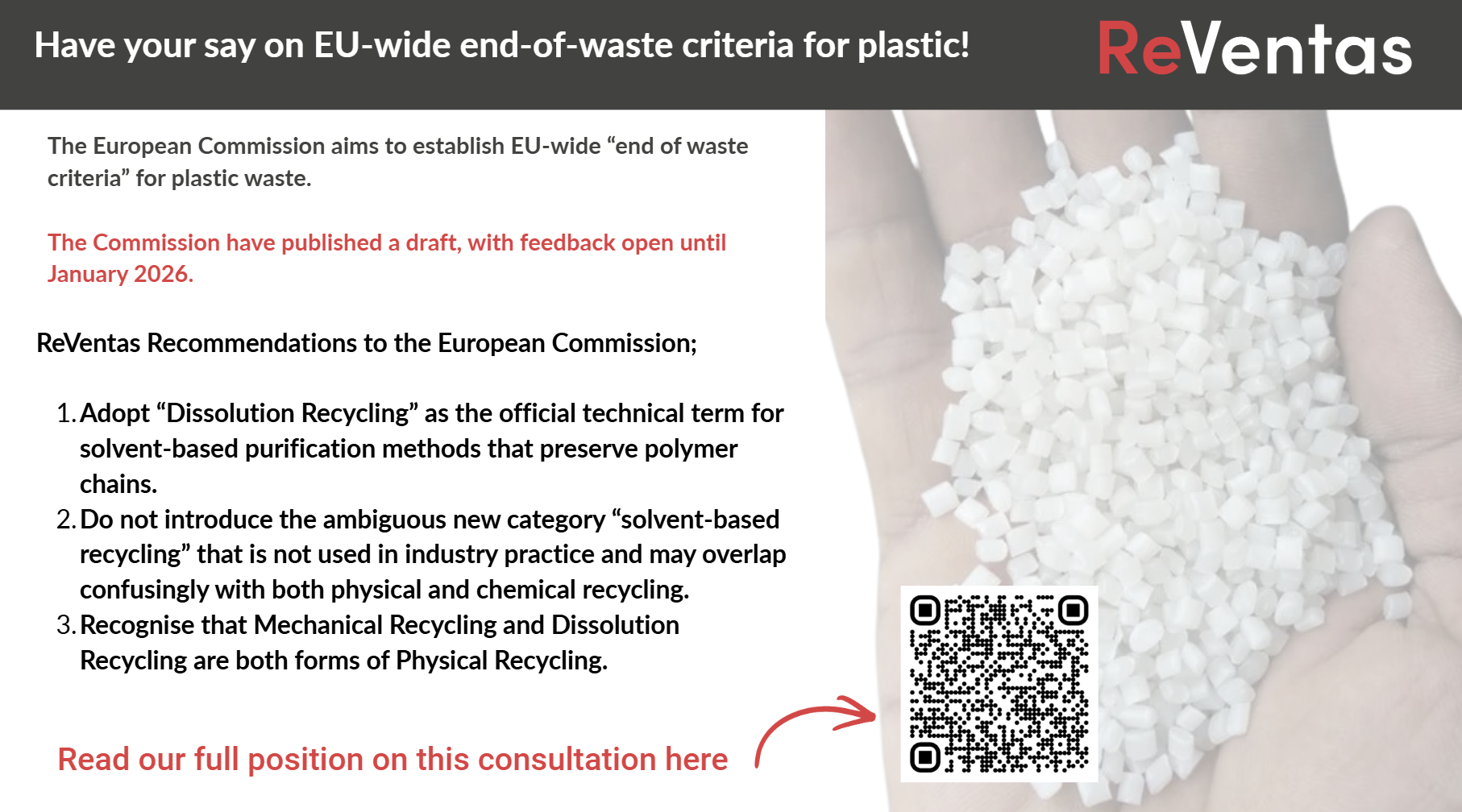
The European Commission aims to establish EU-wide “end of waste criteria” for plastic waste. The Commission have published a draft, with feedback open until January 2026. ReVentas is making the below comments and encourages others to join us in commenting.
You can make your comments by visiting https://ec.europa.eu/info/law/better-regulation/info/law/better-regulation/have-your-say/initiatives/14848-Plastic-waste-EU-wide-end-of-waste-criteria_en
Proposed Definitions
ReVentas welcomes definitions proposed by the European Commission, however notes a few areas where changes would be beneficial.
In particular, ReVentas is supportive of the following definition;
(7) ‘plastic recyclate’ shall mean the output plastic which has achieved end-of-waste status, and can be used as a secondary raw material to produce new plastic products or articles containing plastic parts;
However, ReVentas recommends changes, for the definitions of (4)’Solvent based Recycling’ and (3) ‘Mechanical Recycling’ as proposed below;
Accurate terminology ensures consistent regulation and market transparency. Mis-labelling dissolution/solvent-based purification methods as a new category risks regulatory inconsistency, market confusion, and unwarranted exclusion of high-quality recycled polymer material from End-of-Waste status.
Proposed Definitions from ReVentas to upgrade End of Waste criteria
- Physical (Material) Recycling shall mean processing of plastics waste into secondary raw material through physical sorting, separation and purification processes such as mechanical recycling (sorting, melting, filtration), delamination, dissolution recycling [dissolution, extraction (solid-liquid or liquid-liquid or supercritical fluid)], precipitation, and other technologies currently under development, that only change the shape or aggregate state of polymers and retain the polymeric chains that constitute the plastic;
Note1: physical recycling is a “preparation for reuse” because it is a repairing process for polymers in plastic products that become waste.
Note2: material recycling and physical recycling are synonyms.
- Dissolution Recycling (recommended technical term) shall mean processing of plastics waste into secondary raw material through physical sorting, separation and purification methods such as dissolution, extraction, precipitation or filtration that only change the aggregate state of polymers and retain the polymeric chains that constitute the polymer;
- Mechanical Recycling
shall mean processing of plastics waste into secondary raw materials through mechanical methods such as sorting, grinding and extruding (re-granulating) that only change the shape of polymers and retain the polymeric chains that constitute the polymers;
ReVentas Recommendations to the European Commission
- Adopt “Dissolution Recycling” as the official technical term for solvent-based purification methods that preserve polymer chains.
- Do not introduce the ambiguous new category “solvent-based recycling” that is not used in industry practice and may overlap confusingly with both physical and chemical recycling.
- Recognise that Mechanical Recycling and Dissolution Recycling are both forms of Physical Recycling.